
On this page 7 sections

Twenty-nine states have at least one signed cotton candy placement on the open record of October 2026; twenty-one have none. What changes across them is which licence floss sugar triggers and who issues it, and whether anyone has placed a specialty machine there before you. The venue’s share barely moves: 40% of net almost everywhere.
At a glance
| Measure | Figure |
|---|---|
| States with a cotton candy placement | 29 of 50 |
| States with none on the record | 21 |
| States outside the specialty locator’s coverage | 2 (Alaska, Hawaii) |
| Busiest state | Wisconsin, 7 signed venues |
| Venue share | 30–50% of net, median 40%, across 75 placements |
| Minimum term | 16 months, in all 87 listings |
| Half of all placements | Bowling alleys, indoor playgrounds, family entertainment centres, trampoline parks |
Which states have cotton candy placements already?
Twenty-nine states appear on the record, and they are not the states a population map would predict. Mississippi has as many signed cotton candy venues as California, and Wisconsin has more than Texas, Florida or New York.
| Signed cotton candy venues | States |
|---|---|
| Seven | Wisconsin |
| Six | California, Mississippi, Ohio |
| Five | Florida |
| Four | Georgia, Kentucky, New York |
| Three | Michigan, New Jersey, Pennsylvania, Tennessee, Texas |
| Two | Illinois, Kansas, Maine, Massachusetts, New Hampshire, South Carolina, Virginia |
| One | Alabama, Arkansas, Connecticut, Louisiana, Maryland, Missouri, North Carolina, Oklahoma, Washington |
| None | Alaska, Arizona, Colorado, Delaware, Hawaii, Idaho, Indiana, Iowa, Minnesota, Montana, Nebraska, Nevada, New Mexico, North Dakota, Oregon, Rhode Island, South Dakota, Utah, Vermont, West Virginia, Wyoming |
The pattern is indoor recreation density rather than headcount. A state full of bowling alleys and indoor playgrounds in small cities produces placements; a state whose leisure market is outdoors and seasonal produces fewer, whatever its population. That is why the Upper Midwest and the Deep South both over-index here while the Mountain West is absent.
An empty row is a signal, not a verdict. It means no locator has published a specialty placement there, so you would be the first on that record and should price the risk accordingly.
Who places specialty machines, and where will they not go?
PinPoint Vending is the locator whose specialty placements are on the open record, naming cotton candy and robotic ice cream among the machines it places, and it says it covers every state except Alaska and Hawaii. Those two states are therefore outside this cluster’s recommendation entirely, and the guides for them say so instead of pretending otherwise.
General vending locators work the other side of the market. Nationwide Vending Locators places drink, snack, coffee, smart coolers and micro markets from $400 a location, payable only after installation, and claims all 50 states. For a snack machine that model is attractive; for a cotton candy machine it is largely untested, because the company publishes no specialty placements anywhere.
The fee models differ as much as the coverage. A per-placement fee is paid on delivery; the specialty route charges $1,000 upfront on its Standard plan — $800 refundable, $200 processing — plus $100 a month across a 16-month minimum, which is $2,600 over the term before the deposit returns. In a state with no placements on the record, that is money paid ahead of a market nobody has demonstrated.
Which licence does floss sugar need, and from whom?
Floss sugar is food in every state, so a cotton candy machine lands inside the food vending rules rather than beside them. The licence notes collected for 19 states fall into three patterns, and the amount varies more than the rule does.
| Pattern | States recorded | What it costs or requires |
|---|---|---|
| No vending licence or decal | North Carolina, Pennsylvania, Tennessee, Virginia, Washington | Nothing to file for the machine; Pennsylvania still wants your name and address on it |
| A state licence for food machines | Florida ($21 a year, perishable food), Illinois (a decal per machine with sales tax registration), Kentucky, Michigan (from MDARD), Wisconsin ($125 a year plus $9 per machine) | Packaged snacks and canned drinks are often exempt — floss sugar is not |
| A county or local health licence | California, New York, Ohio, Maryland ($2.50 per machine a year, county Circuit Court clerk) | The host’s address picks the office, so two machines can mean two filings |
Wisconsin is worth pausing on, because it is both the busiest state on the record and the dearest licence on it. The state’s own vending page sets the operator licence at $125 a year plus $9 per machine, running July 1 to June 30, and requires the operation to be supported from a licensed food processing plant, retail food establishment or food warehouse.
Its exemption list is where floss sugar gets interesting. Wisconsin exempts a machine dispensing only “candy, gum, nuts, nut meats, cookies, or crackers,” along with bottled, prepackaged or canned soft drinks. Whether a machine that spins sugar into cotton candy on demand counts as dispensing candy, or as preparing food, is a question for DATCP rather than something to assume — and the answer decides whether the $125 applies at all. Ask before you file.
Two further notes sit beside the table. Claw and prize machines are licensed separately in Georgia, Massachusetts, New Jersey, Ohio and Texas, so mixed equipment means two sets of paperwork. And Mississippi’s note is unresolved: a state vending privilege tax appears in the code, but it could not be confirmed as collected — a question for the agency rather than an assumption.
What share do venues take, state to state?
The share is the least state-dependent number in this subject. Across the 75 cotton candy placements that set one, it runs 30% to 50% of net sales with a median of 40%, and the 16-month minimum term is identical in all 87 listings.
That consistency is useful when you negotiate, because it means a quoted share can be checked against a national pattern rather than a hunch. At an $8 serving and a 40% share the operator keeps about $4.54: the venue’s $2.48 comes off net sales of $6.20 after the $1.80 the agreements deduct, then roughly $0.50 of sugar, stick and topping and $0.48 of card processing. At 30% the operator keeps $5.16; at 50%, $3.92.
Assumptions: a serving priced at $8; the venue’s percentage applied to net sales, which the agreements reach by deducting $1.80 first; supplies at $0.50; card processing at 5.95%, or $0.48. Not included: the monthly placement fee, the state or county licence, insurance, travel and the machine payment. What a cotton candy machine earns runs the version with those in.
Which venue types sign, in every state?
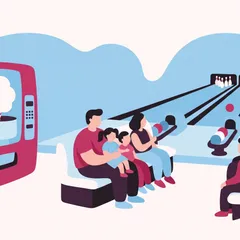
Four venue types account for half of all cotton candy placements, and they are the same four in every state on the record: bowling alleys (18), indoor playgrounds (14), family entertainment centres (11) and trampoline parks (7). Arcades add four more.
| Venue type | Cotton candy placements |
|---|---|
| Bowling alley | 18 |
| Indoor playground | 14 |
| Family entertainment centre | 11 |
| Trampoline park | 7 |
| Arcade | 4 |
| Everything else (hotels, escape rooms, malls, water parks and the rest) | 26 |
What those four share is children, dwell time and a roof. Offices, hospitals and schools appear nowhere in the 87 listings, and the absence is consistent enough to treat as a rule rather than a sampling quirk; the requirements a site has to meet explains which of them floss sugar actually depends on.
Use that list to read any state’s prospects, including the 21 with no record. Count the bowling alleys and indoor playgrounds within an hour’s drive, not the state’s population, and you have a better forecast than a coverage map gives you.
Which state guide should I read?
Pick a state from the directory below and its guide covers the venues signed there, the shares those venues agreed, the licence a floss sugar machine needs locally and what the state’s air does to the product. Wisconsin tops the record with seven signed cotton candy venues, four states hold six or five between them, and the dash in the third column marks the twenty-one states with nothing signed yet.
| State | Signed cotton candy venues | Shares agreed |
|---|---|---|
| Alabama | 1 | 40% |
| Alaska | 0 | — |
| Arizona | 0 | — |
| Arkansas | 1 | 40–50% |
| California | 6 | 40–50% |
| Colorado | 0 | — |
| Connecticut | 1 | 40% |
| Delaware | 0 | — |
| Florida | 5 | 30–50% |
| Georgia | 4 | 30–50% |
| Hawaii | 0 | — |
| Idaho | 0 | — |
| Illinois | 2 | 30–40% |
| Indiana | 0 | — |
| Iowa | 0 | — |
| Kansas | 2 | 40–50% |
| Kentucky | 4 | 40% |
| Louisiana | 1 | 40% |
| Maine | 2 | 40% |
| Maryland | 1 | 40% |
| Massachusetts | 2 | 30% |
| Michigan | 3 | 35–40% |
| Minnesota | 0 | — |
| Mississippi | 6 | 40–50% |
| Missouri | 1 | 40% |
| Montana | 0 | — |
| Nebraska | 0 | — |
| Nevada | 0 | — |
| New Hampshire | 2 | 40% |
| New Jersey | 3 | 35–50% |
| New Mexico | 0 | — |
| New York | 4 | 30–50% |
| North Carolina | 1 | 30% |
| North Dakota | 0 | — |
| Ohio | 6 | 40–50% |
| Oklahoma | 1 | 40% |
| Oregon | 0 | — |
| Pennsylvania | 3 | 30–40% |
| Rhode Island | 0 | — |
| South Carolina | 2 | 40% |
| South Dakota | 0 | — |
| Tennessee | 3 | 40% |
| Texas | 3 | 40–50% |
| Utah | 0 | — |
| Vermont | 0 | — |
| Virginia | 2 | 30–40% |
| Washington | 1 | 40% |
| West Virginia | 0 | — |
| Wisconsin | 7 | 30–40% |
| Wyoming | 0 | — |
A dash is an opening rather than a warning. It means no specialty placement has been published in that state, so a venue there would be the first on the record and should price that accordingly. Alaska and Hawaii are the exception with a reason attached: both sit outside the specialty locator’s stated coverage.
Frequently asked questions
Which states have the most cotton candy vending placements?
Wisconsin leads with seven signed venues on the October 2026 record, then California, Mississippi and Ohio with six each and Florida with five. Twenty-nine states have at least one; twenty-one have none.
Can you place a cotton candy machine in any state?
Nearly. PinPoint Vending, whose specialty placements are on the open record, says it covers every state except Alaska and Hawaii. In the 21 states with no placement on the record, a machine would be the first one there, which is a different risk from joining an established market.
What licence does a cotton candy machine need?
It varies by state, and floss sugar counts as food in all of them. Five recorded states require no vending licence at all, five issue a state food vending licence, and others leave it to a county or local health district. Wisconsin’s is the dearest on the record at $125 a year plus $9 a machine.
What share do venues take on a cotton candy machine?
Thirty to fifty per cent of net sales, with a median of 40% across the 75 cotton candy placements that set a share. The share is figured after the $1.80 a serving the host agreements deduct, not on the sticker price.
What kind of venue signs a cotton candy machine?
Indoor recreation, overwhelmingly. Bowling alleys account for 18 of the 80 cotton candy placements, indoor playgrounds 14, family entertainment centres 11 and trampoline parks 7 — half the total between them. Offices, hospitals and schools appear nowhere on the record.
Sources
- Ohio Revised Code 3717.07, Food safety rules — licence fees (Ohio Laws and Administrative Rules)
- Nationwide Vending Locators: service, fees and coverage pages, checked October 6, 2026
- Vending Machines, Wisconsin Department of Agriculture, Trade and Consumer Protection
- Types of Business Licenses, Comptroller of Maryland
- PinPoint Vending: state coverage, pricing and open marketplace listings, collected October 5 and 6, 2026