
On this page 8 sections

To pitch a cotton candy machine to a venue, ask for the owner or general manager, show the machine spinning and offer a share of net sales; 40% is the most common figure in signed listings. Arrive with answers on floor space, power, mess, sugar and the snack bar, and close with a one-page agreement.
How do you get a cotton candy machine placed, step by step?
Getting a cotton candy machine placed takes five steps, from a shortlist of venues to a signed agreement and a booked delivery. The first two happen before you ask anyone for anything: choosing venues where children wait with an adult, and counting those families at the busy hour. Each step has its own section below.
Field Notes
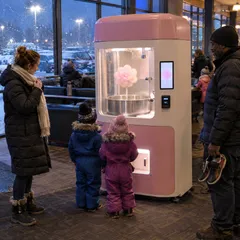
- Shortlist venues where children wait with an adult, such as bowling alleys, indoor playgrounds and family entertainment centers.
- Visit each one at its busy hour as a customer and count the families, then come back on a weekday morning to pitch.
- Pitch the person who signs vendor agreements, with the video, the spec card and the script.
- Send the one-page offer within two days, with the spot, the share and your service schedule in writing.
- Sign the agreement, then line up the permit, the power and the delivery date before the machine ships.
Who should you pitch at a venue?
Pitch the person who can sign a placement agreement, because getting a cotton candy machine placed takes a signature: at an independent family venue, usually the owner or general manager, not the snack-bar lead or the front desk. Chain and franchise locations may need sign-off from a regional office, and malls route common-area placements through a specialty leasing manager. Ask who signs vendor agreements before you pitch anyone.
Where to start, by venue type:
- Independent bowling alley: the owner or general manager. Bowling centers often run their own food and beverage service, according to the federal industry definition, so the person who signs also owns the snack bar you will be asked about. Our cotton candy machine bowling alley guide covers the rest.
- Family entertainment center or trampoline park: the location’s general manager first, then whoever approves vendors for the chain or franchise; our family entertainment center guide covers the rest.
- Indoor playground: the owner, or the manager the owner names for vendor deals.
- Mall: the specialty leasing or temporary tenant manager; our mall placement guide explains how those licenses work.
- Zoo, aquarium or stadium: whoever holds the food rights, often a concessionaire; see cotton candy vending machine at a zoo and cotton candy vending machine at a stadium.
Visit on a weekday morning, before school lets out. A manager on a Saturday afternoon is running the building, not reading spec sheets.
What should you bring to the first visit?
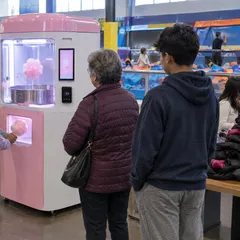
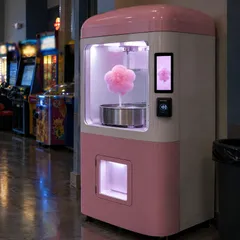
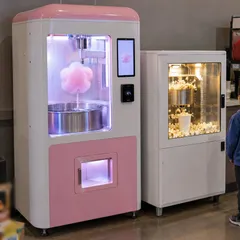
Bring five things that let a manager decide in one meeting. They are a 30-second video of the machine spinning, a spec card with its footprint and power draw, a certificate of insurance, a one-page draft agreement and a written example of the revenue share. Measurements matter more for a cotton candy robot than for a snack machine, because the robot stands nearly 8 feet tall.
- Video: the spin is the product. Film a full serving from order to pickup, about 90 seconds on one maker’s spec.
- Spec card: one maker lists its cotton candy robot at 52.8 inches wide, 29.5 inches deep and 95.3 inches tall, 380 kilograms, with a 2,200-watt maximum draw, 20 amps at 110 volts. A reseller’s sheet for the VX model lists 25 amps at 110 volts, so print the numbers for your exact model.
- Insurance certificate: mall and office-tower managers often require general liability with $1 million per-occurrence limits, so have a certificate ready at that level.
- One-page agreement: the spot, the share, the payment schedule, service response, insurance and how either side ends it.
- Share example: the math for one $8 serving, written out, so the manager sees the venue’s cut in dollars.
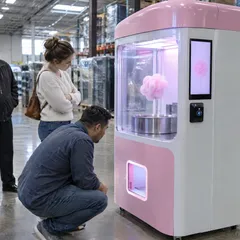
Bring a tape measure too. Measure the spot, the doorways and the path from the loading door before you leave; our location requirements checklist lists the clearances worth checking.
What is the cotton candy machine pitch script, line by line?
The pitch script runs in five short beats: who you are, the show, the money, the logistics and the ask. The lines below are a starting point for a bowling alley or family entertainment center manager, so swap in the venue’s details and your own terms. Stop talking once the manager starts asking where the machine would go, which is a good sign.
- Opening: “Hi, I’m [name]. I place robotic cotton candy machines in family venues around [town]. Do you have two minutes now, or is there a better time this week?”
- The show: “It spins each serving in about 90 seconds while the kid watches, in any of 30 built-in shapes. [Play the video.] Nobody on your team touches it.”
- The money: “You’d get 40% of net sales, meaning sales minus a fixed $1.80 a serving for cost of goods, paid monthly with the sales report from the machine. At $8 a serving, that’s $2.48 to you on every one sold.”
- The logistics: “It needs a spot about 53 by 30 inches near an outlet on its own circuit, which an electrician sizes from the amps on the machine’s plate. I restock and clean it every week, and I carry [$1 million] in liability coverage.”
- The ask: “Can I show you where I think it would sell, and leave this one-page agreement for you to look over?”
Leave the agreement and the spec card behind whatever the answer. Follow up by email within two days with the same terms in writing.
How do you answer a venue manager’s objections?
Answer a venue manager’s objections to a cotton candy machine with facts the manager can check: the machine’s specs, the Food Code, federal nutrition guidance and the venue’s share of each sale. Four objections are specific to a robot that spins sugar on site: the mess, the sugar, the power bill and the snack bar. The answers below are this journal’s recommendations, not tested scripts.

How do you answer “it will make a sticky mess”?
Answer the mess objection with where the sugar goes and who cleans it. A cotton candy robot makes each serving inside the machine and hands it out finished on a stick, so the sugar that reaches the floor is what customers drop. Offer a mat and a lidded trash can beside the machine, and write your cleaning schedule into the agreement.
The trash can has to sit outside the machine: section 5-501.14 of the FDA Food Code, the federal model behind state and local food rules, bars a trash receptacle inside a vending machine. Offer to empty it on every service visit.
Then name the schedule: at least one visit a week, more at busy times, and a response time if the venue calls about a spill or a fault. Our service schedule explains why busy machines need more than one visit a week. A named service day and a phone number are easier for a manager to approve than a promise to keep things tidy.
How do you answer “we don’t want more sugar for kids”?
Answer the sugar objection honestly: cotton candy is a treat, and you should not pitch it as anything else. A 1-ounce serving of packaged cotton candy carries 28 grams of sugar and 110 calories, and the federal Dietary Guidelines for 2025–2030 call added sugars not recommended and urge avoiding them, especially for children. Pitch an occasional celebration treat, and accept a no from health-branded venues.
The label figures come from one brand’s cotton candy entry in USDA FoodData Central; a machine-spun serving varies with the pattern, so weigh one from your own machine. The guidelines’ own wording is on the federal Real Food site, worth reading before a manager quotes it to you.
What you can offer is information and placement. Federal rules under 21 CFR 101.8 require calorie signs only from operators of 20 or more vending machines, but posting the calories anyway answers the question before a parent asks it. Offer a spot near the party rooms or the exit rather than beside the toddler area.
We would not argue nutrition with a pediatric practice or a health club. Thank them and take the pitch to the bowling alley down the road.
How do you answer “it will run up our power bill”?
Answer the power objection with arithmetic the manager can check against the venue’s own bill. One maker rates its robot at 2,200 watts at most, and a serving spins for about 90 seconds. Even if every second ran at full draw, 100 servings would use about 5.5 kilowatt-hours, around 80 cents at the July 2026 U.S. commercial average price.
That average is 14.53 cents per kilowatt-hour in the Energy Information Administration’s monthly table; swap in the venue’s own rate if the manager has it. Game Room Shop’s sheet for the VX lists up to 3,000 watts, which would put 100 servings nearer $1.10.
Neither figure counts the heat that keeps the sugar warm between servings, which the maker does not publish, so ask for the idle wattage before you quote a monthly number. Against the $2.48 the venue earns on each $8 serving, the spin itself costs about a cent. Write down who pays for power, and who pays for a new circuit if the spot needs one, in the agreement.
How do you answer “it will compete with our snack bar”?
Answer the snack-bar objection with the venue’s cut and its labor bill. Under the 40% net-share terms most common in signed cotton candy listings, the venue earns $2.48 on every $8 serving without buying sugar, paying staff or running a register. A snack bar’s cotton candy, if it sells any, needs an attendant at a machine; the robot needs nobody.
Make the comparison concrete for the manager: the venue’s share arrives with a monthly sales report, and the machine keeps serving while the snack-bar line is long. The pitch is that the robot catches impulse buyers the counter would miss, families who watched a serving spin and stopped.
If the snack bar already spins cotton candy and it sells well, do not fight it. Offer to place the machine away from the counter, or pitch a different venue.
What revenue share should you offer?
Offer 40% of net sales unless the venue’s type or terms argue otherwise; that is the share in 55 of the 75 cotton candy listings that set one on PinPoint Vending’s marketplace in October 2026. The rest run from 30% to 50%. In those agreements, net sales are what is left after a flat $1.80 per serving is set aside for cost of goods.
The edges are what matter in a pitch: retail and food sites hold five of the six 50% deals, while bowling alleys account for six of the eleven at 30%. Five more cotton candy listings left the share to be set with the venue.
Start at 40%, go lower at a bowling alley if the manager pushes back, and expect a store or a deli to ask for more. Our guide to cotton candy vending machines at grocery stores shows why stores start at 50%, and our guide to cotton candy machine revenue share covers the full range by venue type and how to calculate payouts.
What happens after the venue says yes?
After the venue says yes, put the deal in writing within two days: the exact spot, the share and how it is calculated, the payment schedule, service response time, insurance, power and how either side can end it. Then line up the permit and the outlet before the machine ships, because a robot that arrives without a circuit or a health permit earns nothing; the start-up cost guide puts every step in order.
PinPoint Vending’s free vending machine contract template sets starting defaults: a 12-month initial term, 30 days’ notice after that, a two-business-day service response, $1 million per occurrence in insurance and an outlet within 6 feet of the agreed spot. Treat it as a draft for a lawyer in your state, not a finished contract.
Check three things before delivery day:
- Permit: many states and counties license food vending machines; our permit guide lists where.
- Power: confirm a dedicated circuit at the rating your model needs, and who pays the electrician.
- Path: a robot that weighs 380 kilograms and stands 95.3 inches tall needs measured doorways, a clear route and a floor that can take it.
The venue’s share is only part of what decides whether the placement pays; our guide to how much a cotton candy machine makes runs the whole calculation.
Frequently asked questions
How do you approach a business about placing a cotton candy machine?
Go in person on a quiet weekday morning and ask for the owner or general manager, the person who signs vendor agreements. Show a short video of the machine spinning, leave a one-page offer with the spot, the share and your service schedule, and follow up in writing within two days.
Should I pay a venue rent or a percentage?
A percentage keeps the venue’s interest tied to sales and costs you little in a slow month; flat rent suits only a venue whose traffic you have measured. Every cotton candy marketplace listing that set terms in October 2026 uses a percentage of net sales, most often 40%.
How many venues do I need to pitch to get one yes?
Plan for more noes than yeses, and measure your own rate rather than borrowing someone else’s: log every venue you pitch and every yes. Start with pre-qualified family venues, the ones with a waiting crowd and an outlet near a good spot, and after your first 10 visits divide the yeses by the pitches to see how many calls one placement takes.
Can someone pitch venues for me?
Yes. Locator services make the calls and sign the venue for a fee, usually an enrollment charge plus a monthly placement fee. Compare any service’s guarantee and refund terms before you pay.
Sources
- NAICS 713950: Bowling Centers, U.S. Census Bureau
- Cotton Candy Robot specifications, Sweet Robo
- Sweet Robo Cotton Candy Robot VX, Game Room Shop
- Vending machine business insurance, VendSoft
- FDA Food Code 2026, U.S. Food and Drug Administration
- Cotton candy (FDC ID 1925984), USDA FoodData Central
- Dietary Guidelines for Americans, 2025–2030: Real Food, U.S. Department of Health and Human Services and U.S. Department of Agriculture
- 21 CFR 101.8, Vending machines, eCFR
- Electric Power Monthly, Table 5.6.A: Average price of electricity by state and sector, U.S. Energy Information Administration