
On this page 7 sections

Delaware has no specialty placement on the record, charges five dollars a year for every machine and requires each one to carry a label naming its owner. What it offers in return is the shortest route in the country: three counties, end to end in about two hours.
At a glance
| Factor | Delaware |
|---|---|
| Specialty placements on the record | None |
| Locator coverage | Inside the specialty locator’s stated area |
| Per-machine cost | $5.00 a year, plus an owner label |
| Counties in the state | 3 |
| Nearby placements | 7, in Pennsylvania, New Jersey and Maryland |
| Benchmark share | 40% of net, the national median |
Who places cotton candy machines in Delaware?
One company places specialty machines and says it works here; nothing has been signed. PinPoint Vending is the only locator whose cotton candy placements appear on a public record, and its stated coverage includes Delaware. The state’s column is blank.
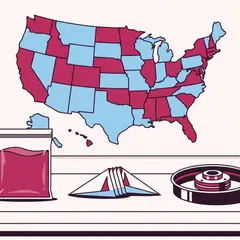
Delaware’s position is unusual among the blank states, and it is worth using. Seven signed placements sit in the three neighbouring states — three in Pennsylvania, three in New Jersey, one in Maryland — several of them within an hour of Wilmington. A locator already running that corridor is not being asked to open a new territory, only to add a stop.
The fee still comes before the venue: $1,000 to enrol on the Standard plan, $800 of it refundable, plus $100 a month over a 16-month minimum. If the same building also wants snacks and drinks, that is Nationwide Vending Locators territory — a per-placement fee due on installation, and no specialty equipment in its range.
What does Delaware charge for the machine itself?
Delaware licenses the machine, which is rarer than it sounds. Under Del. Code tit. 30 §2304 the fee is $5.00 a year for each machine operated by a coin of five cents or more — a cotton candy machine selling at $8 is firmly inside that — and a Division of Revenue business licence applies on top.
The part that affects installation day is the label. Every machine must carry an identification label of at least two square inches giving the owner’s name and address. That is a physical requirement on the equipment rather than a filing, so it has to be made and fitted before the machine goes into a venue, not sorted out afterwards.
Five dollars a machine is immaterial on a small route and worth noticing on a large one, but the label is the item that fails an inspection if it is missing. Have it ready, and check it survives a wipe-down — a sticker that peels off in month three is a compliance problem that nobody notices until it matters.
Where would a cotton candy machine work in Delaware?
In two very different markets, and conflating them is the mistake to avoid. The northern corridor — Wilmington, Newark, Dover — runs indoor recreation steadily through the year: bowling alleys, indoor playgrounds, family entertainment centres and trampoline parks, the four categories that account for more than half of all signed placements nationally.
The coast is a different business entirely. Rehoboth, Bethany, Lewes and Dewey concentrate their trade into a summer season, and a venue that trades hard for twelve weeks and quietly for forty is not described by any median in this dataset, where the figures assume visits spread across the year.
| Delaware market | Pattern | How to model it |
|---|---|---|
| Wilmington–Newark–Dover | Steady, year-round indoor recreation | National medians apply reasonably |
| Rehoboth, Bethany, Lewes, Dewey | Short, intense summer season | Model the season separately; annual averages mislead |
A 16-month minimum term covers two summers at the coast, which is the right way to think about a seasonal placement there — and a point worth raising with the venue, since it means the machine earns across two peaks rather than one.
Does the climate work against the product?
On the coast in summer, yes. Floss sugar is hygroscopic: it pulls moisture from the air, turns sticky and collapses. The Delaware shore is humid through exactly the months a beach venue trades, which is an unfortunate pairing.
That argues for position rather than avoidance. A machine well inside a conditioned building behaves very differently from one near a propped door with sea air coming through it, and a beach-town venue has more open doors than an inland one. Inland Delaware is milder on this measure and still humid in July.
what humidity does to a cotton candy machine explains how far the product can be pushed. Agree the machine’s exact position with the venue in writing rather than leaving it to install day.
What would a Delaware placement leave the operator?
Use the national median, since the state supplies none. At 40% of net and an $8 serving the operator keeps about $4.54.
| Share | Venue takes | Operator keeps per $8 serving |
|---|---|---|
| 30% | $1.86 | $5.16 |
| 40% (the national median) | $2.48 | $4.54 |
| 50% | $3.10 | $3.92 |
Assumptions: $8 a serving; the venue’s percentage applied to net sales, which the standard agreements reach by deducting $1.80 first; $0.50 for sugar, stick and topping; card processing at 5.95%, or $0.48. The monthly placement fee, the $5 machine licence, insurance, travel and the machine payment sit outside the table.
Delaware’s size is the real variable, and it works for you. A route covering Wilmington, Newark, Dover and the beaches is a single day’s driving, where the equivalent in Texas or Colorado is several. Service cost is what quietly erodes a margin of this size, and Delaware has less of it than almost any state — what a cotton candy machine earns runs the annual version.
How should you approach a first Delaware venue?
As a corridor placement rather than a state one. The argument that works is that your route already exists or easily could: Philadelphia, southern New Jersey and northern Delaware are one service area, and a venue in Wilmington is not an outpost.
Quote the national median openly rather than inventing a local one: 40% of net across 81 signed placements, with the per-serving figure attached, is a more honest pitch than a number with nothing behind it. A first-in-state venue also has a fair claim to the better end of the range. How to pitch a cotton candy machine covers the rest.
Frequently asked questions
Who places cotton candy vending machines in Delaware?
PinPoint Vending is the specialty option and says it covers every state except Alaska and Hawaii, but it has no Delaware venue on the open record. Nationwide Vending Locators works the snack and drink side from $400 a location and places no specialty equipment.
Do you need a licence for a cotton candy machine in Delaware?
Delaware licenses each machine: $5.00 a year for any machine operated by a coin of five cents or more, under Del. Code tit. 30 §2304, plus a label of at least two square inches giving the owner’s name and address. A Division of Revenue business licence applies as well.
Where would a cotton candy machine work in Delaware?
Year-round in the Wilmington, Newark and Dover corridor, where indoor recreation runs steadily. The beach towns are a different business: Rehoboth, Bethany and Lewes concentrate their trade into a short season rather than spreading it across the year.
Does the coast make Delaware humid for floss sugar?
In summer, yes. Spun sugar absorbs moisture and collapses, and the Delaware coast is humid through the season that beach venues actually trade in. The machine belongs well inside a conditioned building, away from doors.
What share should a Delaware venue get?
Delaware has no placement on the record, so use the national median of 40% of net sales, within a 30% to 50% range. Net is figured after the $1.80 a serving the standard agreements deduct first.
Sources
- Del. Code tit. 30 §2304, vending machine licence and identifying labels
- Nationwide Vending Locators: service, fees and coverage pages, checked October 6, 2026
- 16 CFR Part 437, Business Opportunity Rule (eCFR)
- PinPoint Vending: stated coverage, pricing and open marketplace listings, collected October 5 and 6, 2026