
On this page 6 sections

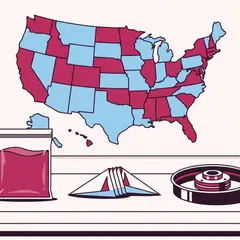
Colorado offers spun sugar a genuinely helpful climate and no local track record. PinPoint Vending says it covers every state except Alaska and Hawaii, so Colorado is served — but it has signed nothing here. The state’s own asks are a decal on each machine and a food licence from one of two very different offices.
At a glance
| Factor | Colorado |
|---|---|
| Specialty placements on the record | None |
| Locator coverage | Inside the specialty locator’s stated area |
| Climate for floss sugar | Semi-arid; favourable most of the year |
| Per-machine cost | An identification decal for every machine |
| Food licence | Local public health agency, or the state in nine counties |
| Benchmark share | 40% of net, the national median |
Who places cotton candy machines in Colorado?
One company places specialty machines and says it works here; its Colorado record is blank. PinPoint Vending is the only locator whose cotton candy placements appear on any public record, and Colorado is inside its stated coverage of 48 states. Nothing has been signed in the state, and the nearest documented placements are in Kansas and Texas.
For a Colorado operator this is a question of distance more than of willingness. Ask what has been signed within a day’s drive of the Front Range before you pay anything, and lean on the six-month guarantee, which refunds the enrolment fee with $1,000 on top if no location is presented in that window. In an unworked state that clause is doing most of the work.
The fee runs ahead of the venue either way: $1,000 to enrol on the Standard plan, $800 refundable, plus $100 a month across a 16-month minimum. Nationwide Vending Locators charges from $400 a location after installation but handles snack, drink, coffee and micro market equipment rather than specialty machines.
Does Colorado’s climate help the product?
On the only measure that matters to spun sugar, yes. Floss sugar is hygroscopic: it pulls moisture out of the air, turns sticky and collapses, which is why the product behaves differently in Denver and in New Orleans.
Colorado’s Front Range is semi-arid. Denver averages around 15 inches of precipitation a year and low relative humidity for most of it, which puts the state alongside Arizona and well away from the Gulf Coast on the variable that decides whether a machine’s output holds its shape. Altitude itself is not the factor; dryness is.
Two practical notes keep that from being a free advantage. Summer afternoon thunderstorms raise humidity sharply for short periods, and ski-town venues move a lot of damp outerwear and melting snow through their doors, which is a local moisture source a desert venue does not have. The machine belongs well inside the building either way — what humidity does to a cotton candy machine puts figures on where the product starts to fail.
What does Colorado charge for the machine itself?
Colorado identifies the machine, not only the business. The state requires a sales tax licence from the Department of Revenue together with an identification decal bought for each machine, so the cost scales with how many machines you run rather than sitting flat.
The food licence is the part that varies by address. In most of Colorado the local public health agency issues the retail food establishment licence a food machine needs. The state department licenses directly in only nine counties: Clear Creek, Dolores, Gilpin, Moffat, Ouray, Park, Pitkin excluding the City of Aspen, Rio Blanco and San Juan.
Four of those nine are mountain counties with real visitor economies, so a resort-focused route may deal with the state while a Denver route deals with a county agency. Establish which office covers each venue before you commit to it, because the fee, the form and the inspection practice all follow from that.
Where would a cotton candy machine sign in Colorado?
In the same four categories that carry the record everywhere else, all of which the Front Range has in quantity: bowling alleys, indoor playgrounds, family entertainment centres and trampoline parks together account for more than half of the 87 national placements.
| Venue type | Share of national placements | Colorado presence |
|---|---|---|
| Bowling alley | 18 of 87 | Denver metro, Colorado Springs, Fort Collins |
| Indoor playground | 15 of 87 | Widespread along the Front Range |
| Family entertainment centre | 11 of 87 | Denver, Aurora, Colorado Springs |
| Trampoline park | 7 of 87 | Denver metro |
Colorado also offers something the dataset has never tested: the mountain resort economy, where families are concentrated indoors in the late afternoon and evening through a long winter season. That is a plausible fit and an unproven one, and the honest way to treat it is as a hypothesis you are testing at your own cost rather than a market the record endorses.
Winter is the argument to lead with on the Front Range too. Indoor recreation carries a larger share of the year in Colorado than in a mild-weather state, which is exactly the dwell time a machine sells into, and how to pitch a cotton candy machine to a venue covers how to put it.
What would a Colorado placement leave the operator?
Use the national median, since Colorado supplies no figure. At 40% of net and an $8 serving the operator keeps about $4.54.
| Share | Venue takes | Operator keeps per $8 serving |
|---|---|---|
| 30% | $1.86 | $5.16 |
| 40% (the national median) | $2.48 | $4.54 |
| 50% | $3.10 | $3.92 |
Assumptions: $8 a serving; the venue’s percentage applied to net sales, which the standard agreements reach by deducting $1.80 first; $0.50 for sugar, stick and topping; card processing at 5.95%, or $0.48. The monthly placement fee, the Colorado decal, the food licence, insurance, travel and the machine payment sit outside the table.
Two Colorado costs deserve a line of their own in your own model. The per-machine decal recurs annually and scales with the route, and a resort route adds mountain driving in winter, which is the kind of service cost that looks trivial per trip and significant per year.
Frequently asked questions
Who places cotton candy vending machines in Colorado?
PinPoint Vending is the specialty option and says it covers every state except Alaska and Hawaii, but it has no Colorado venue on the open record. Nationwide Vending Locators works the snack and drink side from $400 a location and places no specialty equipment.
Is Colorado’s climate good for a cotton candy machine?
Yes, on the measure that matters. Floss sugar absorbs moisture and collapses, and Colorado’s Front Range is semi-arid, with far less humidity than the southeast. The machine still belongs well inside a conditioned building.
Do you need a permit for a cotton candy machine in Colorado?
Two things. A Colorado sales tax licence from the Department of Revenue, with an identification decal bought for each machine. And a retail food establishment licence for a food machine — from your local public health agency in most of the state, or from the state department in nine named counties.
Where would a cotton candy machine work in Colorado?
Front Range indoor recreation: bowling alleys, indoor playgrounds, family entertainment centres and trampoline parks around Denver, Colorado Springs, Fort Collins and Aurora. Mountain resort venues are an untested idea rather than one the record supports.
What share should a Colorado venue get?
Colorado has no placement on the record, so use the national median of 40% of net sales, within a 30% to 50% range. Net is calculated after the $1.80 a serving the standard agreements deduct first.
Sources
- Retail food licensing, Colorado Department of Public Health and Environment
- Climate normals for Denver, National Weather Service
- Nationwide Vending Locators: service, fees and coverage pages, checked October 6, 2026
- PinPoint Vending: stated coverage, pricing and open marketplace listings, collected October 5 and 6, 2026