
On this page 7 sections

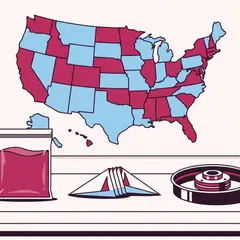
California holds six cotton candy placements, the joint deepest specialty record of any state, and every one of them agreed the same 40% of net. PinPoint Vending placed them all. What varies in California is not the deal but the county, because 58 of them permit the same machine differently.
At a glance
| Factor | California |
|---|---|
| Cotton candy placements | 6 of the state’s 7 signed venues |
| Venue share | 40% of net at all six |
| Minimum term | 16 months |
| State vending licence | None |
| Who permits the machine | The county health department for the host’s address |
| Counties in the state | 58, each with its own fee and form |
Who places cotton candy machines in California?
PinPoint Vending placed every specialty machine in the California record, and the record is the deepest in the dataset alongside Ohio and Wisconsin. Its marketplace listed seven signed California venues collected on October 5, 2026, of which six run a cotton candy machine, signed between May and September of that year.
The geographic spread is the part worth weighing. Yucca Valley sits in the high desert, San Jose and Livermore in the Bay Area, Palmdale and Valencia north of Los Angeles, Oceanside on the coast near San Diego. A locator working that many separate markets in four months is a different proposition from one with a single cluster, which is the question to ask anywhere else.
The fee still arrives before the venue does: $1,000 to enrol on the Standard plan, $800 of it refundable, plus $100 a month across a 16-month minimum. Two of California’s venues are premium-tier instead, which means $2,000 to enrol and $200 a month and requires a venue reporting 100,000 visitors a year. For the snack and drink side, Nationwide Vending Locators charges from $400 a location after installation and places no specialty equipment.
Why did two California venues sign on the same day?
Palmdale and Valencia are the most interesting entry in the state’s record: two entertainment venues, both premium tier, both reporting exactly 100,000 visitors a year, both signed on September 2, 2026. Identical figures on the same date across two cities 30 miles apart point to one agreement covering two sites rather than two negotiations.
That matters to an operator in two ways. A venue group that will sign for several sites at once is the most efficient prospect in this trade, and the specialty market has few of them — the other 85 placements in the record are almost all single sites. And a reported figure that is identical at two venues is a planning number rather than a count, so treat the 100,000 as what the group uses rather than what either door recorded.
If you are pitching California, ask whether the venue is part of a group before you discuss one location. How to pitch a cotton candy machine to a venue covers the approach, and the group case is worth preparing differently.
What does California require before the machine switches on?
California has no state vending licence, which regularly surprises operators who expect the most regulated state in the country to have the most vending paperwork. The permit that matters is issued by the county health department covering the host’s address, and floss sugar is food, so a cotton candy machine is inside the food vending rules rather than beside them.
With 58 counties, the practical effect is that California is not one jurisdiction but dozens. The six specialty venues sit across at least five counties — San Bernardino, Los Angeles, Santa Clara, Alameda and San Diego — and each sets its own fee schedule, application form and inspection practice. A machine in Livermore and a machine in Oceanside involve two unrelated offices.
Plan the filings before the placements rather than after. Ask the locator in writing which party applies for each county permit and whether its fee covers the work, because a permit in someone else’s name is not one you can rely on.
What do the six California placements show?
A single share and a mixed reporting record. Every cotton candy venue in the state agreed 40% of net; the only 50% in California is a mall in Ceres running a flexible machine, which fits the national pattern where pass-through venues are paid more.
| City | Venue | Tier | Reported visitors | Share |
|---|---|---|---|---|
| Palmdale | Entertainment venue | Premium | 100,000 a year | 40% of net |
| Valencia | Entertainment venue | Premium | 100,000 a year | 40% of net |
| Livermore | Family entertainment centre | Standard | 65,000 a year | 40% of net |
| Yucca Valley | Bowling alley | Standard | 35,000 a year | 40% of net |
| San Jose | Escape room | Standard | Not reported | 40% of net |
| Oceanside | Trampoline park | Standard | Not reported | Not reported |
Three of the six report no visitor count. For an operator weighing a California placement that is the gap to fill yourself: ask the venue for its own number and work out what the machine is actually being offered, rather than inferring it from a state with a reputation for scale.
The Livermore family entertainment centre is the strongest documented venue in the state on traffic, at 180 visitors a day. The Yucca Valley bowling alley, at 96 a day, is the weakest — well under the 137 median for bowling alleys nationally, which makes its 40% share look generous to the venue rather than to the operator.
What does a California placement leave the operator?
At the 40% every California venue agreed, an $8 serving leaves about $4.54: the venue takes $2.48 of net sales of $6.20 after the $1.80 deduction, supplies run roughly $0.50, and card processing at 5.95% takes $0.48.
| Share | Venue takes | Operator keeps per $8 serving |
|---|---|---|
| 30% | $1.86 | $5.16 |
| 40% (every California specialty venue) | $2.48 | $4.54 |
| 50% (the Ceres mall) | $3.10 | $3.92 |
Assumptions: $8 a serving; the venue’s percentage applied to net sales, which the agreements reach by deducting $1.80 first; $0.50 for sugar, stick and topping; card processing at 5.95%, or $0.48. The monthly placement fee, the county permit, insurance, travel and the machine payment are outside the table.
With the share settled at 40% across the state, the variables that decide a California placement are traffic and travel. A route spanning Yucca Valley and Oceanside is five hours of driving; one built inside the Bay Area is not, and what a cotton candy machine earns shows how quickly service trips erode a margin this size.
Where else in California would a machine sign?
California’s record already covers six venue types, which is unusually broad, but it has no indoor playground and no water park — categories that sign elsewhere and that California has in quantity. Indoor playgrounds alone account for 15 of the 87 national placements.
The state’s advantage is climate in reverse: coastal California is mild enough that outdoor recreation competes with indoor venues year-round, which is the opposite of the argument that works in Ohio or Wisconsin. Inland, in the Central Valley and the desert, summer heat drives families inside exactly as it does in Arizona. Pitch Fresno, Bakersfield, Sacramento and the Inland Empire on the summer case and the coast on something else.
Frequently asked questions
Who places cotton candy vending machines in California?
PinPoint Vending, which has six cotton candy placements across California on the open record — in Yucca Valley, Palmdale, Valencia, San Jose, Livermore and Oceanside. No other locator publishes specialty placements anywhere.
Do you need a permit for a cotton candy machine in California?
California issues no state vending licence. Food vending machines are permitted by the county health department covering the host’s address, so the county decides the fee, the form and the inspection. With 58 counties, a route across the state can mean several separate filings.
What share do California venues take on a cotton candy machine?
Forty per cent of net sales at every one of the six cotton candy placements in the state, which matches the national median. The only California venue at 50% is a mall in Ceres running a flexible machine rather than a specialty one.
Which California venues have cotton candy machines?
Six: a bowling alley in Yucca Valley, entertainment venues in Palmdale and Valencia, an escape room in San Jose, a family entertainment centre in Livermore and a trampoline park in Oceanside. They were signed between May and September 2026.
How much does a cotton candy machine make in California?
At an $8 serving and the 40% share every California venue agreed, the operator keeps about $4.54 after the venue’s cut, roughly $0.50 of sugar, stick and topping, and card processing at 5.95%.
Sources
- Retail food code and local enforcement agencies, California Department of Public Health
- Nationwide Vending Locators: service, fees and coverage pages, checked October 6, 2026
- California Civil Code §§1812.200–1812.221, seller assisted marketing plans (California Legislative Information)
- PinPoint Vending: pricing page and open marketplace listings for California, collected October 5 and 6, 2026