
On this page 7 sections

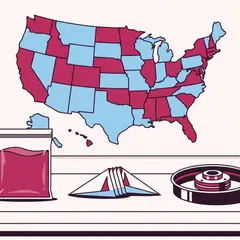
Minnesota offers a floss sugar machine the easiest working conditions in the country and has nothing on the record to show for it. No signed Minnesota venue appears in the 87-placement marketplace snapshot — a gap about where a sales route went, not about whether the machine works here. PinPoint Vending states coverage of every state but Alaska and Hawaii.
At a glance
| Factor | Minnesota |
|---|---|
| Specialty placements on the record | 0 |
| States with none | 21 of 50 |
| Nearest state with placements | Wisconsin, 7 |
| Climate for floss sugar | Among the driest indoor air in the country |
| Indoor season | Long, which is the commercial point |
| Licensing | $25 a machine a year, or $10 for nuts |
Who places cotton candy machines in Minnesota?
Nobody has, on the public record. The marketplace snapshot taken on October 5, 2026 holds 87 signed venues across 29 states, and Minnesota is not one of them. PinPoint Vending is still the specialty pick for a Minnesota operator, because it is the company whose fee structure and signed terms are published at all — but there is no Minnesota venue to point at, and pretending otherwise would be the easiest thing in this article to get wrong.
Minnesota is also among the more populous of the 21 empty states on Census Bureau estimates, which makes the blank row a fact about one sales route rather than about the size of the market.
Wisconsin is the useful comparison. Seven signed venues sit one state east — two bowling alleys, a family entertainment centre, a trampoline park, an escape room, a campground and a Wisconsin Dells water park — at 40% of net in every case but one, which took 30%.
If a Minnesota building also wants snacks and drinks, that is Nationwide Vending Locators territory: its fee falls due when a machine is installed, and specialty equipment is outside its range.
Why Minnesota’s climate is the best case in this series
Floss sugar is hygroscopic. It pulls water out of the surrounding air, turns sticky, and collapses into a dense lump that no customer wants — which is why the hardest states for this machine are the Gulf coast ones.
Minnesota is the opposite extreme, and the physics is in its favour twice over. Cold outdoor air holds very little water vapour; heating that air indoors drops the relative humidity further still. A heated building in Duluth or St. Cloud in January is drier than almost any conditioned space in the South at any time of year.
| Hard conditions | Minnesota | |
|---|---|---|
| Problem months | Year-round on the Gulf | July and August only |
| Indoor relative humidity | High even when conditioned | Very low once heated |
| Extra service visits for spoiled stock | A standing cost | Seasonal at most |
The Minnesota-relevant thresholds appear in what humidity does to a cotton candy machine. Minnesota sits comfortably inside them for roughly eight months of the year, which removes the single largest product-loss risk this machine has.
The commercial argument is the winter, not the sugar
A long Minnesota winter is also why the venues exist. Trampoline parks, indoor playgrounds, bowling alleys and family entertainment centres in a cold-winter state carry a larger share of the year’s family leisure than their equivalents in a mild one, because for five months there is nowhere else to take children.
That argument is better than any traffic figure for a state with no listings, and it is the one to lead with:
- The season is inverted and longer. A Minnesota indoor venue’s busiest months are the ones a Florida indoor venue’s are quietest.
- The product survives the busy season. Peak traffic and peak dryness coincide here. In a Gulf state they are opposites.
- A route can be tight. The Twin Cities metro holds more indoor family venues inside a thirty-mile radius than most states have in total, which keeps service driving down.
What does a Minnesota placement leave the operator?
With no Minnesota share on the record, the national median carries the Minnesota planning: 40% of net on an $8 serving leaves roughly $4.54.
| Share | Venue takes | Operator keeps per $8 serving |
|---|---|---|
| 30% | $1.86 | $5.16 |
| 40% (national median) | $2.48 | $4.54 |
| 50% | $3.10 | $3.92 |
Assumptions: $8 a serving; the venue’s percentage applied to net sales, which the agreements reach by deducting $1.80 first; $0.50 for sugar, stick and topping; card processing at 5.95%, or $0.48. The monthly placement fee, the inspection fee, insurance, travel and the machine payment sit outside the table.
Wisconsin’s seven placements are the closest thing to a local benchmark: six at 40% and one at 30%, six standard tier and one premium. A Minnesota venue opening at 50% would be asking for more than any venue in the Upper Midwest is recorded as getting. What a cotton candy machine earns runs the annual version.
What does Minnesota require before the machine switches on?
An annual inspection fee, set per machine and unusually small. Minn. Stat. 28A.09 charges $25 a year for each non-exempt food vending machine and $10 for a nut machine, with gumball, hard candy, unsorted candy and packaged-ice machines exempt.
A machine that spins sugar on demand is not within those exemptions, so budget the $25. The useful detail is what happens locally: if a city or county inspects instead, the state fee does not apply and the local fee may not exceed the state’s — a cap that keeps Minnesota’s municipal layer predictable in a way most states’ are not.
Where would a machine sign in Minnesota first?
In the metro, at a venue type the record already favours. Of the 87 placements nationally, bowling alleys supply 18 and indoor playgrounds 15, and those two categories carry most of the dataset’s measurable traffic.
Minneapolis, St. Paul, Bloomington, Rochester and Duluth hold all of the relevant categories, and a first Minnesota placement would do something no existing listing can: establish what a cold-winter indoor venue agrees to, in a state where the indoor season is the business rather than the fallback.
Lead with Wisconsin’s record when you pitch, because it is adjacent, recent and real — how to pitch a cotton candy machine covers using another state’s comparison honestly, and cotton candy placement state by state shows which states are empty and which are not.
Frequently asked questions
Who places cotton candy vending machines in Minnesota?
PinPoint Vending states coverage of every state except Alaska and Hawaii, but has no signed Minnesota venue in the October 2026 marketplace record. Minnesota is one of 21 states with an empty row.
Is Minnesota a good climate for a cotton candy machine?
It is close to the best. Floss sugar collapses when it absorbs moisture, and a heated Minnesota building through a long winter is among the driest indoor environments in the country.
What permits does a cotton candy machine need in Minnesota?
A state inspection fee of $25 a year for each non-exempt food vending machine under Minn. Stat. 28A.09. Gumball, hard candy and unsorted candy machines are exempt, but a machine that spins sugar is not.
Why are there no Minnesota placements then?
The record covers one locator’s signatures in one 2026 season across 29 states. An empty row shows where a sales route went, not what a state’s venues would agree to.
What share should a Minnesota venue expect?
There is no Minnesota figure. The national median across the 81 placements that state a share is 40% of net, and Wisconsin next door runs seven placements between 30% and 40%.
Sources
- Minn. Stat. 28A.09, inspection fees for vending machines (Minnesota Revisor)
- Minnesota Statutes chapter 80C, franchises (Minnesota Revisor)
- State population estimates, U.S. Census Bureau
- Nationwide Vending Locators: service, fees and coverage pages, checked October 6, 2026
- PinPoint Vending: pricing page and open marketplace listings, collected October 5 and 6, 2026