
On this page 8 sections

A cotton candy machine suits an indoor playground when it stands where parents wait and families leave: by the parent seating, party rooms or exit, outside the play area. Across the 15 playgrounds among the open marketplace listings cited below, the 11 with counts post a 40,000-visitor median, and most take 40% of net sales.
At a glance
| Factor | Indoor playgrounds |
|---|---|
| Typical traffic | Median 40,000 visitors a year across the 11 listed playgrounds that report a count (7,000 to 150,000); venue-reported, not audited |
| Venue share | 40% of net sales at 12 playgrounds, 30% at one; two have not set a share yet |
| Who signs | The owner or general manager |
| Best spot inside | Beside the parent seating, outside the party rooms or on the way out, never inside the play area |
| Season | Year-round indoors; weekday traffic shifts with school calendars |
| Verdict | Fewer visitors than a bowling alley, but nearly every family brings a buyer: strong where the venue books parties |
Source: the 15 indoor playground listings among the 87 open listings on PinPoint Vending’s marketplace, October 5, 2026.
Why does an indoor playground suit a cotton candy machine?
An indoor playground suits a cotton candy machine because the venue exists for young children, so nearly every family through the door brings a buyer, and the adults sit and wait while the children play. A machine that spins a treat in front of a child is a show during the visit and a reward at the end of it, and the adult paying is already sitting nearby.
Signed demand reflects that. Indoor playgrounds hold 14 of the 80 cotton candy listings in the marketplace data, second only to bowling alleys with 18. One more playground listing, in Farmingdale, New York, signed for a drink and snack machine instead.
The trade-off is size. The playgrounds’ median of 40,000 visitors a year sits below the medians for bowling alleys (50,000), family entertainment centers (65,000) and trampoline parks (100,000) in the same listings. A playground has to make up in buyers what it lacks in bodies.
The request rate is what makes the category stand out. PinPoint Vending’s product data by venue records 14 of 15 indoor playgrounds asking for a cotton candy machine, part of 122 of 149 machine slots across its signed entertainment venues naming one, against national figures that put coffee, water and salty snacks top in offices and sports drinks and protein bars top in gyms. The venue type, not the national ranking, decides the product.
How many visitors does an indoor playground bring a cotton candy machine?
An indoor playground brings a cotton candy machine a median of 40,000 visitors a year, going by the 11 playgrounds in the marketplace listings that report a count. The counts run from 7,000 in Bowling Green, Kentucky, to 150,000 in Ocean City, Maryland, and eight of the 11 report between 30,000 and 75,000. Four playgrounds have no count at all.
| Indoor playground location | Visitors a year | Venue share | Tier | Signed |
|---|---|---|---|---|
| Ocean City, MD | 150,000 | 40% | Premium | Jul 2026 |
| Mobile, AL | 75,000 | 40% | Standard | Jul 2026 |
| Sylvania, OH | 75,000 | 40% | Standard | Jul 2026 |
| Kennewick, WA | 50,000 | 40% | Standard | Jul 2026 |
| Sebring, FL | 50,000 | 40% | Standard | Jul 2026 |
| Muskogee, OK | 40,000 | 40% | Standard | Aug 2026 |
| Boston, MA | 30,000 | Not set yet | Standard | Jul 2026 |
| Toccoa, GA | 30,000 | 40% | Standard | Jul 2026 |
| Tupelo, MS | 30,000 | 40% | Standard | Aug 2026 |
| Greenville, MS | 22,000 | 40% | Standard | Aug 2026 |
| Bowling Green, KY | 7,000 | 40% | Standard | Jul 2026 |
| Ann Arbor, MI | Not counted | 40% | Standard | Jul 2026 |
| Blasdell, NY | Not counted | 30% | Standard | Aug 2026 |
| Farmingdale, NY (drink and snack) | Not counted | Not set yet | Standard | Jul 2026 |
| Manchester, NH | Not counted | 40% | Standard | Jun 2026 |
Ask what a count measures. A figure built from paid admissions may count only children, while a door counter counts everyone, and the listings do not say which method each venue used. All of the counts are the venues’ own and are not audited.
At the median, the listings’ own daily conversion gives about 110 visitors a day. Only the Ocean City playground, at 150,000, reaches the 100,000-visitor line that marks a Premium listing ($2,000 to enroll, $200 a month); the other 14 are Standard, at $1,000 and $100 a month.
Ask which months run slow, too. The seasonal sales guide shows how school calendars move weekday traffic at indoor family venues.
What share of sales does an indoor playground take?
An indoor playground takes 40% of a cotton candy machine’s net sales in 12 of the 13 marketplace listings that set a share; the other, in Blasdell, New York, set 30%. Net sales are what is left after a fixed $1.80 cost of goods comes off each serving, so at $8 the venue receives $2.48 and the operator keeps about $4.54 once materials ($0.50) and card fees ($0.48) are paid.
Two listings leave the share to be set with the venue: the Boston playground and the Farmingdale drink-and-snack listing. Every listing carries a 16-month minimum term.
With so little variation, the share is the easy part of a playground deal, and the revenue share guide explains how the net-sales basis works across venue types. The harder parts are the spot, the party plan and the cleaning promise.
How do birthday parties change the math at an indoor playground?
Birthday parties can matter more to a cotton candy machine at an indoor playground than walk-in traffic does, because a party arrives as a group of children with an adult already paying for treats. In our illustration, two party rounds a weekend sell about three times as many servings as walk-in families do at a 40,000-visitor playground.
The Math (an illustration, not a forecast)
Assumptions: a 40,000-visitor playground, the listings’ median; one walk-in visit in 100 ends in a sale; two parties a weekend each buy a round of 12 servings; 4.33 weekends a month; $8 a serving; the venue’s 40% of net sales, figured after the $1.80 cost of goods, is $2.48 a serving; materials (sugar, stick, topping) run about $0.50 and card processing at 5.95% about $0.48, so the operator keeps about $4.54 ($8 − $2.48 − $0.50 − $0.48).
| Source of sales | Servings a month | Operator keeps | Venue’s share |
|---|---|---|---|
| Walk-in families | 33 | $151 | $83 |
| Party rounds | 104 | $472 | $258 |
| Both | 137 | $624 | $341 |
After a $100 placement fee, walk-in sales alone leave about $51; with the party rounds, about $524, before insurance and travel. Those costs are added in what a cotton candy vending machine makes at $8 a serving, and where the playground charges admission, our guide to what to charge per serving makes the case for $10. The party count is the number to get from the owner: how many parties the playground books on a typical weekend, and how many children each one includes.
Birthday parties also bring a timing problem. Sweet Robo, which makes one of the robots in circulation, puts each serving at 90 seconds on its spec page, so a round for 12 children takes 18 minutes of spinning and a round for 20 takes 30. That caps the machine at about 40 servings an hour, with walk-in families waiting behind the party.
Agree three things with the owner before the first party: when in the party the round happens, how it is paid, and who tells walk-in families about the wait. A host can tap a card for each serving, or the venue can add the round to its party package and settle with you at the agreed share.
Where should a cotton candy machine stand in an indoor playground?
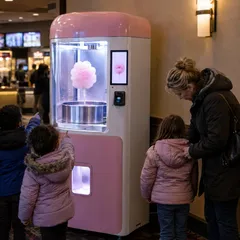
A cotton candy machine should stand where adults wait and families leave an indoor playground: beside the parent seating, in the corridor outside the party rooms or on the path to the exit. Keep it outside the play area, so floss stays off the slides and nets, and away from the check-in desk, where families are still paying admission and getting settled.
| Spot | Verdict | Why |
|---|---|---|
| Beside the parent seating | Strong | Adults wait there, in sight of the children |
| Outside the party rooms | Strong | Parties arrive and leave as groups |
| On the path to the exit | Good | Every family passes once, on the way out |
| Inside the play area | No | Sticky hands on the equipment and children running past the cabinet |
| At the check-in desk | Weak | Families are busy paying and getting settled |
| Next to the café counter | Weak | Competes with the venue’s own food sales |
Secure the cabinet. A current robot weighs 380 kilograms and stands 95.3 inches tall, and a playground is full of children who climb. Intermatic’s manual for its cotton candy vendor describes securing the machine by locking its rear wheel brakes, chaining it to a permanent structure, or both; ask your own machine’s maker for its anchoring method before the first busy Saturday.
Check the screen height as well. Advisory 308.1 of the 2010 ADA Standards gives reach ranges for elements designed mainly for children, for forward or side reaches:
| Age | Highest reach | Lowest reach |
|---|---|---|
| 3 and 4 | 36 inches | 20 inches |
| 5 through 8 | 40 inches | 18 inches |
| 9 through 12 | 44 inches | 16 inches |
A touchscreen above those heights means a parent picks the design or lifts the child, which slows every sale. The table is guidance worth asking the maker about, not a code requirement for the machine.
The same standards require at least 36 inches of clear width on an accessible route, so leave that much floor open past the machine and the children gathered in front of it. Run the spot through the 11 location checks for power, floor and air before you sign.
What will an indoor playground owner ask before saying yes?
An indoor playground owner or general manager will ask about sticky hands on the equipment, sugar, the café’s sales, cleaning and the permit before saying yes. Each has a practical answer. Offer a spot outside the play area, a trash can and wipes beside the machine, a cleaning schedule in the agreement, a share of every sale, and a permit filed in the operator’s name before the machine arrives.

- Sticky hands: ask whether the playground keeps food to a café or party area; if it does, the machine belongs in that area or on the way out.
- Sugar: the pitch guide covers how to answer the sugar objection without arguing nutrition.
- The café: a machine beside the café counter competes with it; one by the exit sells after the café’s last sale of the visit.
- Cleaning: agree who wipes the cabinet and the floor around it, and how often; the maintenance guide sets out the operator’s side of the schedule.
- Permit: the playground listings’ license notes run from no vending license or decal in Washington to a $2.50 yearly fee per machine from the county Circuit Court clerk in Ocean City, Maryland. In New York, the note is a local health permit for every food or drink machine. The cotton candy machine permit rules by state cover the health side.
Some owners will know the trade’s norms through an industry group: IAAPA, the attractions industry’s trade association, says more than 1,400 family entertainment center and location-based entertainment businesses are represented in its membership. Either way, bring a one-page summary of the share, the term and the cleaning plan to the first meeting.
Which indoor playgrounds should you skip?
Skip indoor playgrounds that are small and book few parties, that have no spot outside the play area, or whose only outlet sits inside the play zone. A cotton candy machine at a playground lives on families who wait and parties that buy in rounds. A small venue without either cannot carry a monthly placement fee, however many children it serves on a Saturday.
We would skip a playground under about 20,000 visitors a year unless it books parties every weekend. At 7,000 visitors, about one visit in 25 would have to end in a sale just to cover a $100 fee, before the operator earns anything.
A town without a strong playground may still have a bowling alley with a party program and a larger count. If the playground sits inside a shopping center, the cotton candy machine mall guide covers the concourse spot outside its doors.
Frequently asked questions
Is a cotton candy machine a good idea for an indoor playground?
It can be, because nearly every family at an indoor playground brings a child and an adult with time to wait. Place it by the parent seating, the party rooms or the exit rather than inside the play area, and get the venue’s visitor count and weekend party bookings first.
What share of sales does an indoor playground take?
In the 15 indoor playground marketplace listings of October 2026, 12 set the venue’s share at 40% of net sales, one at 30%, and two had not set one yet. Net sales means sales minus a fixed $1.80 cost of goods per serving, so a 40% share pays the venue $2.48 on an $8 sale.
How many visitors does an indoor playground get?
The 11 indoor playgrounds in the October 2026 marketplace listings that report a count give a median of 40,000 visitors a year, from 7,000 to 150,000. Ask whether a count includes the adults who come with each child, because the listings do not say.
Can a cotton candy machine serve a birthday party?
Yes, with a plan for time. A machine that takes about 90 seconds a serving needs 18 minutes to spin a round for 12 children, so schedule the round at a set point in the party and agree in advance how it is paid.
Where should a vending machine go in an indoor playground?
Near where adults wait and families leave: the parent seating, the corridor outside the party rooms or the exit. Keep it outside the play area so sticky hands stay off the equipment, and secure the cabinet the way its maker directs.
Sources
- Family entertainment centers and location-based entertainment, IAAPA
- Department of Justice 2010 ADA Standards for Accessible Design (PDF), including Advisory 308.1 on children’s reach ranges
- Sweet Robo Cotton Candy Robot: technical specifications
- Intermatic IML CFV 04 cotton candy vendor user manual (November 2010), via BMI Gaming