
On this page 9 sections

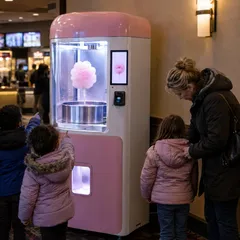
A cotton candy machine works at a family entertainment center (FEC) when it stands where families pause: by the party rooms, the prize counter or the exit. Keep it away from the café. The nine centers in the listings below that report a count have a 65,000-visitor median, and seven of the 11 take 40% of net sales.
At a glance
| Factor | Family entertainment centers |
|---|---|
| Typical traffic | Median 65,000 visitors a year across the 9 listed centers that report a count (10,000 to 100,000); venue-reported, not audited |
| Venue share | 40% of net sales at 7 of 11 centers; 30% at two, 45% at one, 50% at one |
| Who signs | The owner or general manager at an independent center; the head office at a chain |
| Best spot inside | Beside the party-room corridor, near the prize counter or on the path out, clear of the café and the game aisles |
| Season | Year-round indoors; ask for monthly counts, because school calendars move the weekday crowd |
| Verdict | A strong venue type where the center books parties: more visitors than the median bowling alley, and groups that buy in rounds |
Source: the 11 family entertainment centers listed on PinPoint Vending’s marketplace, among the 87 listings open on October 5, 2026.
Why does a family entertainment center suit a cotton candy machine?
A family entertainment center suits a cotton candy machine because it is built around families with children, who come for several activities under one roof and often for a party. IAAPA, the attractions industry’s trade association, describes these venues as running from bowling and trampoline parks to immersive arcades. It counts more than 1,400 of these businesses among its members, who come from over 100 countries.
Signed demand points the same way. All 11 family entertainment center listings in the marketplace data signed for a cotton candy machine. That makes the type the third largest of the 80 cotton candy listings, behind bowling alleys (18) and indoor playgrounds (14).
The big chains say plainly who they serve. Dave & Buster’s Entertainment ran 64 Main Event centers in 22 states at the end of its 2025 fiscal year, and its annual report says those stores “primarily focus on families with children.” That audience is the machine’s: the child watching a spin is the buyer, and the adult paying is standing beside them.
How many visitors does a family entertainment center bring?
A family entertainment center brings a cotton candy machine a median of 65,000 visitors a year, going by the nine centers in the marketplace listings that report a count. That beats the median bowling alley (50,000) and indoor playground (40,000) in the same data. The counts run from 10,000 in Georgetown, Kentucky, to 100,000 in Auburn, Maine, and Slidell, Louisiana.
| Center location | Visitors a year | Venue share | Tier |
|---|---|---|---|
| Auburn, ME | 100,000 | 40% | Premium |
| Slidell, LA | 100,000 | 40% | Premium |
| Hattiesburg, MS | 85,000 | 45% | Standard |
| New Berlin, WI | 75,000 | 40% | Standard |
| Livermore, CA | 65,000 | 40% | Standard |
| Lawrence, KS | 60,000 | 50% | Standard |
| Boca Raton, FL | 46,000 | 30% | Standard |
| Bad Axe, MI | 40,000 | 40% | Standard |
| Georgetown, KY | 10,000 | 40% | Standard |
| Fairburn, GA | Not counted | 30% | Standard |
| O’Fallon, MO | Not counted | 40% | Standard |
The counts are the venues’ own and are not audited, so ask each center how it counts: admission wristbands, waivers, party bookings and door counters all measure different things. The two centers at 100,000 are the only Premium listings of the type, at $2,000 to enroll and $200 a month; the other nine are Standard, at $1,000 and $100. All 11 signed between June 30 and August 21, 2026.
At the median, one visitor in 100 who buys means about 54 servings a month, or $245 for the operator at $4.54 a serving after the venue’s 40%, sugar and card fees. The $150 of monthly fixed costs in our worked examples takes 34 servings to cover, rounded up, or about 0.6% of visits. The earnings guide runs the same math for other venue types.
What share of sales do family entertainment centers take?
Family entertainment centers take 40% of a cotton candy machine’s net sales in seven of the 11 marketplace listings, 30% in two, 45% in one and 50% in one. Net sales here means the price minus the $1.80 per-serving cost of goods written into the agreements, so an $8 serving pays a 40% center $2.48. The operator keeps $4.54 after $0.50 of sugar, stick and topping and a 5.95% card fee.
| Venue share of net sales | Centers | Venue’s take on an $8 serving | Operator keeps |
|---|---|---|---|
| 30% | 2 (Boca Raton, FL; Fairburn, GA) | $1.86 | $5.16 |
| 40% | 7 | $2.48 | $4.54 |
| 45% | 1 (Hattiesburg, MS) | $2.79 | $4.23 |
| 50% | 1 (Lawrence, KS) | $3.10 | $3.92 |
Traffic does not explain the spread. Both 100,000-visitor centers set 40%, the two 30% centers report 46,000 visitors and no count, and the 50% center reports 60,000. Lawrence is also the only family venue among the six cotton candy listings at 50%; the other five are shops, food sellers and a gas station, as the revenue share guide shows.
Our view: offer 40% and spend your negotiating effort on the spot by the party rooms. A center that asks for 50% should show you store-level traffic to justify it.
A wider cut of the same signings points the same way. PinPoint Vending’s summary of 39 signed entertainment venues records 6 of 10 family entertainment centers at 40%, with one each at 45% and 50%, spread across 10 states with one venue apiece, and notes that all 39 venues asked for a cotton candy machine: 23 for the Cotton Candy VX2, 11 for the VX and 5 for the ICEE edition. A center asking 50% is asking above its own category.
Who signs at a family entertainment center, the owner or the chain?
At an independent family entertainment center, the owner or general manager decides on a cotton candy machine; at a chain, expect the call to be made at corporate, not in the building. A franchised center sits between the two: the local owner signs, but the franchise agreement may limit third-party equipment on the floor, so ask before you pitch.
Chains run many centers from one office: Dave & Buster’s Entertainment ended its 2025 fiscal year with 179 Dave & Buster’s stores and 64 Main Event centers. At a chain, expect an outside machine to need approval above the general manager, while an independent owner can say yes in one meeting.
Bring the center’s own numbers to that meeting: its visitor count, the parties it books on a weekend and the share you are offering, written in dollars. The pitch guide has the script and the answers to the snack-bar objection.
Where in a family entertainment center should the machine stand?
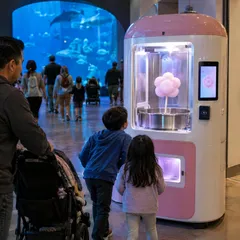
A cotton candy machine should stand where families pause rather than where they play: beside the corridor to the party rooms, near the prize counter where children trade in their tickets, or on the path to the exit. Keep it out of the game aisles, where the machine and its watchers block traffic, and away from the café, which sells to the same parents.

The café matters more than it looks. Dave & Buster’s Entertainment took in $779.3 million from food and beverage in its 2025 fiscal year, about 37% of $2.1 billion in revenue, with games and other entertainment bringing in the rest. A machine beside a center’s café reads as competition; one by the party rooms reads as an extra.
| Spot | Verdict | Why |
|---|---|---|
| Beside the party-room corridor | Strong | Groups arrive and leave together, with an adult paying |
| Near the prize counter | Strong | Children wait there with time to watch a spin |
| On the path to the exit | Good | Every family passes once, at the end of the visit |
| Inside the game aisles | Weak | The machine and its watchers block the walkway |
| Next to the café | Weak | Competes with the center’s own food sales |
| At the front desk | Weak | Families are still paying and getting their wristbands |
Leave room for the crowd a spin draws. The 2010 ADA Standards set a 36-inch minimum clear width for walking surfaces and a 30 by 48 inch clear floor space at a vending machine’s controls, so keep both open past the machine.
Check the circuit as well, because arcade games and the café share the building’s power. One current robot is rated at 20 amps at 110 volts on its maker’s spec page and 25 amps on one reseller’s sheet, so have an electrician size the circuit. The 11 location checks cover the rest.
How do birthday parties and group events change the math?
Birthday parties change the math more than walk-in traffic does, because a party arrives as a group of children with an adult already paying for treats. In the illustration below, four party rounds a weekend roughly quadruple what a 65,000-visitor center’s walk-in families buy, lifting the operator’s month from about $245 to about $1,031 before fixed costs.
The Math (an illustration, not a forecast)
Assumptions: a 65,000-visitor center (the listings’ median) where one walk-in visit in 100 ends in a sale (54 servings a month), plus party rounds of 10 servings over 4.33 weekends a month. Each $8 serving leaves the operator $4.54: $8 − $2.48 to the venue (40% of $8 − $1.80) − $0.50 of sugar, stick and topping − $0.48 card fee (5.95%). Fixed costs are $150 a month on a Standard location.
| Party rounds a weekend | Servings a month | Operator keeps | Left after $150 fixed costs |
|---|---|---|---|
| None | 54 | $245 | $95 |
| 2 | 141 | $640 | $490 |
| 4 | 227 | $1,031 | $881 |
| 6 | 314 | $1,426 | $1,276 |
The venue’s 40% comes to $134 a month with no party rounds and $563 with four.
The party count is the number to get from the center, and the clock is the catch. At 90 seconds a serving, the speed on the maker’s spec page, a round for 10 takes 15 minutes and a camp or school group of 30 takes 45. Agree when in the party the round happens and how it is paid; the indoor playground guide sets out two ways to settle it with the venue.
Does an arcade work like a family entertainment center?
An arcade works like a smaller family entertainment center when its crowd is families, and less well when it is aimed at adults. The four arcade listings in the marketplace data report a median of 55,000 visitors from the three that count, with shares of 30%, 35% and 40% and one share still to be set with the venue.
| Arcade location | Visitors a year | Venue share | Tier |
|---|---|---|---|
| Burlington, NJ | 120,000 | 35% | Premium |
| Kingsport, TN | 55,000 | 40% | Standard |
| Wilmington, NC | 10,000 | 30% | Standard |
| West Chester Township, OH | Not counted | To be set | Standard |
The audience is the test. Dave & Buster’s names “young adults and families” as the primary audience of its namesake stores, against families with children at Main Event. An arcade bar built for the first group has fewer cotton candy buyers than its count suggests.
The license notes on the arcade listings are about the games: claw machines need state and municipal licenses in New Jersey and a state license in Ohio, and Tennessee taxes amusement games separately. The cotton candy machine’s own permit is a food question, which the permit guide answers state by state.
Which family entertainment centers should you skip?
Skip family entertainment centers with a small count and few parties, a café that already spins cotton candy, or no spot outside the game aisles with a circuit of its own. A cotton candy machine at a center lives on families who pause and groups that buy in rounds, and a center without either struggles to carry the monthly fee.
At 10,000 visitors a year, the smallest count among the listed centers, covering $150 of monthly fixed costs takes 34 servings, about 4% of visits, before the operator earns anything. At the 65,000 median, the same 34 servings are about 0.6% of visits.
We would skip any center whose party rooms sit empty on a Saturday afternoon, whatever its annual count. A town without a busy center may still have a bowling alley with leagues and parties, and a center inside a shopping center can be reached through the mall guide. Ask, too, which months run slow; the seasonal sales guide shows how school calendars move weekday traffic.
Frequently asked questions
Can you put a cotton candy machine in a family entertainment center?
Yes. Family entertainment centers are the third most common venue type among the 80 open cotton candy marketplace listings of October 2026, and at an independent center the owner or general manager decides. Ask for a spot beside the party rooms or on the way out rather than next to the café.
What share do family entertainment centers take from a vending machine?
In the 11 family entertainment center listings of October 2026, seven take 40% of net sales, two take 30%, one 45% and one 50%, where net means sales minus a fixed $1.80 cost of goods per serving. At 40%, the venue receives $2.48 on an $8 serving.
How many visitors does a family entertainment center get?
The nine family entertainment centers in the October 2026 marketplace listings that report a count give a median of 65,000 visitors a year, from 10,000 to 100,000. The counts are the venues’ own estimates, so ask how a center counts before you rely on one.
Is an arcade a good place for a cotton candy machine?
An arcade that draws families can work like a small family entertainment center, and the three arcade listings with counts report a median of 55,000 visitors a year. An arcade bar aimed at adults is a weaker fit, because cotton candy sells to children.
How long does a cotton candy machine take to serve a birthday party?
At about 90 seconds a serving, a round for 10 guests takes 15 minutes of spinning and a group of 30 takes 45 minutes. Agree with the center when in the party the round happens, so walk-in families are not left waiting behind it.
Sources
- Family entertainment centers and location-based entertainment, IAAPA
- Dave & Buster’s Entertainment, Form 10-K for the fiscal year ended February 3, 2026, U.S. Securities and Exchange Commission
- Cotton Candy Robot specifications, Sweet Robo
- Sweet Robo Cotton Candy Robot VX, Game Room Shop
- 2010 ADA Standards for Accessible Design, U.S. Access Board