
On this page 7 sections

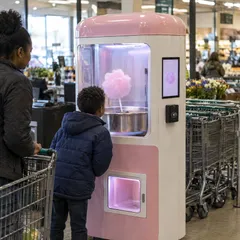
A cotton candy machine works in a movie theater as a lobby novelty on the exit path or in the game room, not beside the concession stand. Theaters keep about 80 cents of each concession dollar after supplies. A machine that steals stand sales costs them money; one that adds sales earns them a share for no labor.
At a glance
| Factor | Movie theaters |
|---|---|
| Typical traffic | About 389,000 patrons per Cinemark theater and 257,000 per AMC theater in 2025 (chain attendance divided by theaters); independents vary widely |
| Venue share | No theater figure exists: none of the 87 listings open on PinPoint Vending’s marketplace on October 5, 2026 is a theater, and its hosts set 30–50% of net sales |
| Who signs | The owner or GM at an independent; head-office food and beverage at a chain |
| Best spot inside | Exit side of the lobby, game room or party room, clear of the concession line |
| Season | Year-round, with peaks around family releases and school breaks |
| Verdict | Pitch independent and family-skewed theaters; skip chain head offices |
Why do movie theaters guard their concession stands?
Movie theaters guard their concession stands because food produces roughly half or more of what a theater keeps from tickets and food combined. In 2025 Cinemark paid out 56.8% of its admissions revenue as film rentals and advertising but spent only 19.6% of concession revenue on supplies, according to its full-year 2025 results. AMC’s 2025 results show 48.1% for film costs and 19.6% for food and beverage costs.

| Full year 2025 | Cinemark | AMC |
|---|---|---|
| Admissions revenue | $1,544.7 million | $2,652.8 million |
| Film costs as a share of admissions | 56.8% (film rentals and advertising) | 48.1% (film exhibition costs) |
| Concession or food and beverage revenue | $1,227.2 million | $1,671.3 million |
| Supplies or food costs as a share of that revenue | 19.6% | 19.6% |
| U.S. concession spending per patron | $8.30 | $8.57 |
| Theaters operated, December 31, 2025 | 496 | 855 |
| Patrons per theater, 2025 (attendance divided by theaters) | About 389,000 | About 257,000 |
The last row is our division of each chain’s worldwide attendance, 193.0 million at Cinemark and 219.4 million at AMC, by its theater count. Those averages are five to eight times the 50,000-visitor median across the marketplace listings that report a yearly count.
Subtract the costs and the pattern is plain. Cinemark kept about 43 cents of each ticket dollar and 80 cents of each concession dollar; AMC kept about 52 cents and 80 cents.
By our arithmetic from the two releases, concessions made up 60% of what Cinemark kept from tickets and food after those direct costs, and 49% at AMC, before labor and rent. That share is what a theater manager is protecting when you walk in proposing a sugar machine a few steps from the candy counter.
Will a cotton candy machine take sales from the concession stand?
A cotton candy machine takes sales from the concession stand whenever it stands where families are already deciding what to buy. Each swapped purchase costs the theater money. An $8 stand sale leaves about $6.43 after supplies; the same $8 spent at the machine earns the theater $2.48 at a 40% share of net sales.
Placed beside the popcorn line, the machine is a bad deal for the theater, and the manager will know it.
The Math (illustration, not a forecast)
Assumptions: $8 a serving at the machine; the theater’s share is figured on net sales after the $1.80 cost-of-goods deduction the marketplace host agreements set, a fixed figure rather than the operator’s actual supply cost; the theater keeps 80.4% of a stand sale after supplies, the 2025 ratio at both chains; stand labor is ignored, which flatters the stand.
| Venue share of net sales | Theater’s take per machine serving | Theater’s net loss when an $8 stand sale moves to the machine | New machine sales needed to offset one moved sale |
|---|---|---|---|
| 30% | $1.86 | $4.57 | 2.5 |
| 40% | $2.48 | $3.95 | 1.6 |
| 50% | $3.10 | $3.33 | 1.1 |
Read the last column as the theater’s test. At a 40% share, the machine has to create about 1.6 sales that would not otherwise happen for every sale it pulls from the stand before the theater breaks even.
Counting the wages of the person behind the counter, the real break-even is a little kinder than the table, but not kind enough to rescue a spot in the concession queue. Our venue pitch guide covers how to answer the snack-bar objection across the desk. A popcorn robot is a harder sell still, because popcorn is what the stand already sells; see the cotton candy vs popcorn vending machine comparison.
Where in a theater lobby does a cotton candy machine belong?
A cotton candy machine belongs on the side of the theater lobby that families cross after the film, or in the game room or party room, where the stand is not selling. A child who has just sat through a two-hour movie walks out ready to move, and the spin show gives the family a reason to stop on the way to the car. Keep the machine in sight of the auditorium exits.
The lobby comes with rules of its own. Under section 403.5.1 of the 2010 ADA Standards, the clear width of a walking surface on an accessible route must be at least 36 inches (U.S. Access Board). A cotton candy machine draws a crowd that stands still to watch, so plan the viewing space beside that 36 inches, not inside it.
- Good spots: the exit-side lobby wall, the game room, the corridor outside party rooms.
- Poor spots: the concession queue, the ticket line, the doors into the auditoriums.
At least one machine maker has pitched cinemas directly. In 2019, MC Global Games named FECs, bowling centers and cinemas as targets for its Cotton Candy World vender ahead of a U.S. launch (RePlay). Run any spot through the 11 location checks before you sign.
Who approves a cotton candy machine at a movie theater?
The owner or general manager approves a cotton candy machine at an independent theater; at a chain, expect the decision to sit with head-office food and beverage or purchasing, not the building manager. Cinema United is the exhibitors’ trade group, renamed from the National Association of Theatre Owners in March 2025. Its members, from the largest chains to hundreds of independent owners, run more than 31,000 U.S. screens.
| Theater type | Who decides | What to ask for first |
|---|---|---|
| Independent, one to a few screens | Owner or GM | A trial spot by the exits |
| Regional chain | Head-office food and beverage | A one-site test at a family-heavy location |
| National chain | Corporate purchasing | Rarely a fit for an operator with one machine |
Independents are where a first pitch belongs. The owner sets the concession menu, can say yes in one meeting, and has the most to gain from anything that brings families back for a Saturday matinee.
What revenue share should you offer a movie theater?
Offer a movie theater 40% of net sales to start, the median across the 81 marketplace listings that set a share, and expect a push toward 50%. No theater appears among the 87 open listings, so there is no theater rate to quote. The closest venues in the data, two entertainment venues in Palmdale and Valencia, California, both set 40%.
Twelve listings ask 50%, and 11 of those 12 are shops and food sellers: retail shops, a deli, gas stations, electronics stores, malls and a food-service site. Venues that sell food or goods of their own ask more, and a theater sells food. The table above shows why: at 50%, the theater needs barely one new sale for each one the machine pulls from the stand.
Write the share on net sales, after the $1.80 cost of goods, rather than on gross. At $8 a serving, 50% of net is $3.10, about 39% of the sale. Our revenue share guide walks through how cotton candy shares are set.
Which movie theaters are worth pitching first?
The movie theaters worth pitching first are independents and small chains that program family films, run weekend matinees and have a game room or party room. Those three features put children in the lobby with nothing between them and the machine. A theater that lives on late shows for adults, or a dine-in cinema that serves at the seat, gives a cotton candy machine little to work with.
Treat a theater as a second placement rather than a base. A bowling alley with weeknight leagues or an indoor playground puts children in front of a machine every day. A theater inside a mall can still pay off through a mall placement on the concourse outside its doors.
Field Notes: the theater site visit
- Stand at the auditorium exits as a family matinee lets out and count the children who pass your spot.
- Ask whether the concession stand stays open after the last show.
- Find the outlet and confirm it is not shared with the popcorn kettle or the drink station.
- Ask who cleans the lobby floor, and how often.
- Ask whose name is on the food permit; your machine may need its own (permit rules by state).
Frequently asked questions
Do movie theaters allow vending machines in the lobby?
Some do, and the decision usually turns on whether the machine competes with the concession stand. A cotton candy machine on the exit side of the lobby or in a game room has a far better chance of a yes than one beside the popcorn counter.
How much do movie theaters make on concessions?
Cinemark reported $1,227.2 million in concession revenue for 2025 and spent 19.6% of it on supplies, while AMC reported $1,671.3 million in food and beverage revenue at the same cost ratio. U.S. patrons spent $8.30 a head at Cinemark and $8.57 at AMC.
Who approves a vending machine at a movie theater?
At an independent theater the owner or general manager usually decides, and can say yes in a single meeting. At a chain the decision tends to sit with head-office food and beverage or purchasing rather than the building manager, so an operator with one machine does better starting with independents.
What share of sales would a theater take from a cotton candy machine?
No public figure exists for theaters specifically. Across the open marketplace listings of October 2026, venue shares run from 30% to 50% of net sales with a 40% median, and a theater that sells its own food is likely to ask for the top of that range.
Sources
- Cinemark fourth quarter and full year 2025 results (Exhibit 99.1), Cinemark Holdings
- AMC Entertainment fourth quarter and full year 2025 results (Exhibit 99.1), SEC EDGAR
- About Cinema United, Cinema United
- National Association of Theatre Owners rebrands as Cinema United (March 18, 2025), Cinema United
- 2010 ADA Standards for Accessible Design, section 403.5.1, U.S. Access Board
- Cotton Candy World successful at IAAPA, RePlay